How to Use RSI Indicator for Crypto Trading Explained
How to Use RSI Indicator for Crypto Trading sets the stage for this enthralling narrative, offering readers a glimpse into a powerful tool that can enhance trading strategies in the dynamic world of cryptocurrencies. The Relative Strength Index (RSI) is a momentum oscillator that measures the speed and change of price movements, giving traders vital insights into potential market trends.
Understanding how to interpret and apply this indicator can significantly impact your trading success.
As we dive deeper into the structure of the RSI, we’ll explore how to set it up effectively, interpret its values, and integrate it with other indicators for a more robust trading strategy. Whether you are a novice trader curious about market dynamics or an experienced investor looking to refine your approach, mastering the RSI can open the door to more informed trading decisions.
Understanding the RSI Indicator
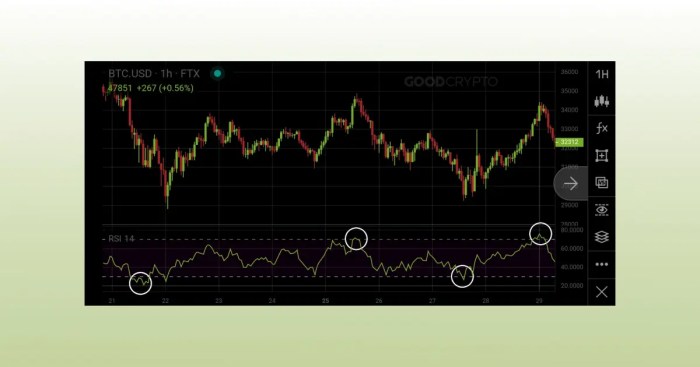
Source: goodcrypto.app
The Relative Strength Index (RSI) is a momentum oscillator that measures the speed and change of price movements. It is widely used in technical analysis to identify overbought or oversold conditions in a market. This makes it particularly valuable for traders in the volatile cryptocurrency space, where price swings can be extreme.The RSI is calculated using the following formula:
RSI = 100 – (100 / (1 + RS))
where RS (Relative Strength) is the average of ‘n’ days’ up closes divided by the average of ‘n’ days’ down closes. Typically, a 14-day period is used for calculation. The resulting value ranges from 0 to 100, with readings above 70 indicating that an asset may be overbought and readings below 30 suggesting it may be oversold.
Significance of RSI Values
The significance of RSI values lies in their ability to signal potential price reversals. Understanding these values helps traders make informed decisions. Here are some key points regarding the implications of RSI readings:
- RSI above 70: This indicates that the asset may be overbought, suggesting a potential price correction or pullback. Traders may consider selling or shorting the asset.
- RSI below 30: This suggests that the asset may be oversold, indicating a potential buying opportunity as prices could rebound. Traders might look to enter a position.
- Divergence: When the price of the asset makes a new high or low that is not mirrored by the RSI, it could indicate weakening momentum, alerting traders to possible trend reversals.
Traders often incorporate the RSI into their strategies alongside other indicators, such as moving averages or MACD, to confirm signals and enhance their trading decisions. Understanding the behavior of the RSI in various market conditions can provide a competitive edge in the dynamic world of cryptocurrency trading.
Setting Up RSI for Crypto Trading: How To Use RSI Indicator For Crypto Trading
To effectively use the RSI indicator in crypto trading, it’s essential to have a clear understanding of how to set it up on your trading platform. The Relative Strength Index is a versatile tool that can help traders identify overbought or oversold conditions in the market. By configuring the RSI correctly, you can enhance your trading strategy and increase your chances of making profitable trades.
Steps to Set Up RSI on a Trading Platform
Setting up the RSI indicator varies slightly depending on the trading platform you are using. However, the general steps are quite similar across most platforms. Here’s how to do it:
1. Open your trading platform
Launch the application or website where you trade cryptocurrencies.
2. Select a cryptocurrency pair
Choose the crypto asset you want to analyze, such as BTC/USD or ETH/BTC.
3. Access the charting tool
Navigate to the chart section of your platform, as this is where you will add the RSI indicator.
4. Add the RSI indicator
Look for an “Indicators” or “Technical Tools” option. Search for “Relative Strength Index” or “RSI” and select it.
5. Adjust the settings
The default RSI setting is usually 14 periods. You can modify this based on your trading strategy.
6. Apply changes
Click “Apply” or “OK” to add the RSI to your chart. You should now see the RSI line displayed beneath the price chart.
Timeframes Suitable for Using the RSI in Crypto Trading
The effectiveness of the RSI can vary depending on the timeframe you choose for your analysis. Here are some timeframes that are commonly used in crypto trading with the RSI:
- 1-Minute Chart: Suitable for day traders looking for quick price movements.
- 15-Minute Chart: Ideal for short-term traders who want to capture small price fluctuations.
- 1-Hour Chart: Allows for a balance between short and medium-term trading strategies.
- 4-Hour Chart: Useful for swing traders who hold positions for a few days.
- Daily Chart: Best suited for long-term investors focusing on overall market trends.
Choosing the right timeframe is crucial as it impacts the sensitivity of the RSI indicator. Shorter timeframes can provide more signals, but they can also lead to more noise and false signals. Conversely, longer timeframes can offer more reliable signals but may generate fewer opportunities.
Customizing RSI Settings for Specific Cryptocurrencies
Different cryptocurrencies can exhibit unique trading behaviors and volatilities. Customizing the RSI settings can help tailor the indicator to better fit the specific asset you are trading. Here are some considerations when customizing the RSI:
1. Adjusting the Period
The standard period for the RSI is 14. For cryptocurrencies known for their high volatility, you may consider using a shorter period (e.g., 7) to capture more rapid price movements. Conversely, for more stable coins, extending the period to 21 or 28 can provide a smoother signal.
2. Setting Overbought and Oversold Levels
While the standard levels for overbought and oversold are 70 and 30 respectively, these can be adjusted based on the historical performance of the specific cryptocurrency. For example, if a coin frequently reaches a level of 80 before reversing, setting the overbought level to 80 may yield better results.
3. Combining with Other Indicators
To enhance the effectiveness of the RSI, integrating it with other indicators like Moving Averages or MACD can provide additional insights and confirmation of trends.By applying these customizations, traders can optimize how the RSI functions with their chosen cryptocurrencies, leading to more informed trading decisions.
Interpreting RSI Values

Source: btcc.com
Understanding how to interpret the Relative Strength Index (RSI) values is crucial for successful crypto trading. The RSI is a momentum oscillator that measures the speed and change of price movements, helping traders identify potential overbought or oversold conditions in the market. By analyzing these values, traders can make informed decisions about their entry and exit points.The RSI operates on a scale from 0 to 100, with specific levels indicating significant market conditions.
Overbought and oversold conditions are essential concepts when interpreting RSI values. An overbought condition occurs when the RSI exceeds 70, suggesting that a cryptocurrency might be overvalued and due for a price correction. Conversely, an oversold condition happens when the RSI falls below 30, indicating that a cryptocurrency might be undervalued and potentially ready for a price increase.
Significance of the 30 and 70 Levels
The levels of 30 and 70 on the RSI scale are critical thresholds that traders watch closely. These levels offer insights into potential market reversals or continuations.
- Overbought Condition (RSI > 70): This level indicates that a cryptocurrency has experienced significant upward momentum and may be overextended. Traders might consider this a signal to sell, or to at least prepare for a potential pullback. For instance, if Bitcoin’s RSI reaches 75 after a rapid price increase, traders may take this as a warning to secure profits.
- Oversold Condition (RSI < 30): This level suggests that a cryptocurrency has been heavily sold off and may be undervalued. This could prompt traders to look for buying opportunities. For example, if Ethereum’s RSI drops to 25 following a market downturn, it might indicate a favorable entry point for traders looking to capitalize on a potential rebound.
Potential trading signals generated by these RSI values can significantly impact trading strategies. Here are examples that illustrate these signals:
- If Litecoin’s RSI rises to 72 and subsequently starts to decline, this may signal traders to consider selling positions, as a correction could be on the horizon.
- When Ripple’s RSI dips to 28 and begins to increase, traders may view this as a buying signal, anticipating that the price will rise in response to the oversold condition.
The RSI is not infallible; it should be combined with other indicators and market analysis for more accurate trading decisions. Thus, understanding how to interpret its values is an essential skill for crypto traders.
Integrating RSI with Other Indicators
To maximize the effectiveness of the RSI (Relative Strength Index) in crypto trading, it’s crucial to combine it with other indicators. This integration can provide a comprehensive view of market conditions and enhance trading decisions. By leveraging multiple indicators, traders can confirm signals and reduce the likelihood of false positives, leading to more informed trading strategies.
Combining RSI with Moving Averages
Integrating RSI with moving averages can create a robust trading strategy. Moving averages help smooth out price data, allowing traders to identify the overall trend. When the RSI aligns with moving average signals, it can reinforce trading decisions. For instance, when the RSI is above 70 (indicating overbought conditions) and the price is above a moving average, it might suggest a potential reversal or correction.
Conversely, if the RSI is below 30 (indicating oversold conditions) while the price remains below a moving average, it may indicate a continuation of the downtrend.
Benefits of Using RSI with MACD
Utilizing the RSI alongside MACD (Moving Average Convergence Divergence) enhances the effectiveness of both indicators. MACD is a trend-following momentum indicator that shows the relationship between two moving averages of a security’s price. When combined with RSI, traders can achieve a more nuanced understanding of market momentum and trend strength.A bullish signal is often identified when the MACD crosses above its signal line while the RSI is also above 50, suggesting strong bullish momentum.
On the other hand, a bearish signal may occur when the MACD crosses below its signal line with the RSI dropping below 50, indicating potential selling pressure.
Complementary Indicators for RSI
Several other indicators can complement the RSI in crypto trading strategies. The following table summarizes these indicators, highlighting their key characteristics and how they enhance trading decisions when used alongside RSI.
| Indicator | Type | Complementary Role |
|---|---|---|
| Bollinger Bands | Volatility | Identifies overbought/oversold conditions in conjunction with RSI. |
| Stochastic Oscillator | Momentum | Confirms potential reversals by indicating overbought or oversold markets alongside RSI. |
| Volume Analysis | Market Strength | Validates RSI signals by providing insights on market participation and strength of price movements. |
| Fibonacci Retracement | Support/Resistance | Augments RSI signals by identifying potential reversal levels based on historical price action. |
Common Mistakes to Avoid When Using RSI
In the world of crypto trading, the Relative Strength Index (RSI) serves as a vital tool for traders. However, its effectiveness can be compromised by common pitfalls that many traders encounter. Recognizing these mistakes is crucial for leveraging RSI to its fullest potential while enhancing trading strategies.Understanding the frequent errors in interpreting RSI signals is the first step in avoiding costly misjudgments.
Many traders fail to consider the broader market context, leading to decisions based solely on RSI readings. This isolation can result in missed opportunities and increased risk. Below are some of the prevalent mistakes to steer clear of when utilizing RSI.
Frequent Errors in Interpreting RSI Signals
Many traders misinterpret RSI readings, which can lead to poor trading decisions. Here are a few common errors to avoid:
- Assuming Overbought and Oversold Conditions Indicate Immediate Reversals: Traders often think that an RSI above 70 indicates a sell signal and an RSI below 30 indicates a buy signal. However, during strong trends, prices can remain overbought or oversold for extended periods.
- Ignoring Divergence: Failing to spot divergence between the RSI and price action is a common mistake. A divergence can signal potential reversals, but traders sometimes overlook this critical insight.
- Using RSI in Isolation: Relying solely on RSI can lead to skewed perspectives. It’s essential to integrate RSI with other indicators for a more comprehensive analysis of market conditions.
Understanding Market Context
Context matters when applying the RSI indicator. Market conditions play a significant role in determining how to interpret RSI values accurately. Traders sometimes neglect to evaluate overall market trends and sentiment, which can lead to misinformed decisions. In any trading environment, trends can dictate the effectiveness of RSI signals. For instance, during a bull market, an RSI reading above 70 may not warrant immediate selling, as the momentum could continue driving prices higher.
Conversely, in a bear market, an RSI reading below 30 might not guarantee a buying opportunity, as prices can continue to decline.
Avoiding False Signals with RSI
To minimize the risk of false signals when applying the RSI in trading, consider the following strategies:
- Combine RSI with Trend Analysis: Before acting on an RSI signal, assess the prevailing market trend to ensure alignment with price movements.
- Use Multiple Time Frames: Analyze RSI across different time frames to validate signals. For example, a bullish signal on a daily chart may carry more weight if the RSI is also bullish on the weekly chart.
- Implement Stop-Loss Orders: To protect against unexpected market movements, employing stop-loss orders can help manage risk, especially when RSI indicates potential reversals.
Real-World Examples of RSI Application
The Relative Strength Index (RSI) is a popular momentum oscillator used by traders to gauge the strength of price movements in the cryptocurrency market. Its ability to identify overbought or oversold conditions makes it a valuable tool in a trader’s arsenal. This section delves into real-world scenarios where the RSI indicator has proven effective, illustrating both successful applications and instances where it led to notable losses.
Case Studies of Successful RSI Usage
Several traders have successfully implemented the RSI to capitalize on market trends in the crypto space. Below are a few noteworthy examples that highlight the versatility of the RSI:
1. Bitcoin Surge in December 2017
During the sharp rise in Bitcoin prices towards the end of 2017, the RSI climbed above 70, signaling an overbought condition. Traders who recognized this signal and took profits were able to avoid significant downturns that followed in early 2018.
2. Ethereum’s Recovery Post-Crash in 2018
Following the market crash in early 2018, Ethereum’s RSI dipped below 30, indicating oversold conditions. Savvy traders who entered the market during this period saw considerable gains as Ethereum’s price began to recover later in the year.
3. Litecoin Buying Opportunity in April 2020
When Litecoin’s price dropped sharply in March 2020, the RSI fell below 30. Traders who acted on this RSI signal found themselves in a favorable position as Litecoin’s price rallied, leading to substantial returns over the following months.
Scenarios Where RSI Led to Significant Gains or Losses
Understanding the potential pitfalls of using the RSI is just as crucial as recognizing its benefits. Here are some scenarios where the indicator led to either significant gains or notable losses:
Gains
A trader noticed Bitcoin’s RSI was consistently below 30 during the 2018 bear market. By accumulating Bitcoin during this period and selling when the RSI returned to 60, the trader experienced a 150% profit over several months.
Losses
During a volatile market phase in 2021, a trader relied heavily on the RSI, selling Ethereum when it hit an RSI of 75. Unfortunately, the price continued to rise for another week, resulting in a missed opportunity for significant profits before a correction occurred.
Step-by-Step Guide for a Practical RSI Trading Strategy
Implementing a practical trading strategy using the RSI can enhance decision-making. Here’s a step-by-step guide utilizing historical data:
1. Select a Cryptocurrency
Choose a cryptocurrency with sufficient trading volume and volatility, such as Bitcoin or Ethereum.
2. Set Up RSI
Configure the RSI on your trading platform with a period of 14 days, which is the standard setting for most traders.
3. Analyze Historical Data
Review historical price data for the chosen cryptocurrency. Look for instances where the RSI crossed the 30 and 70 thresholds.
4. Identify Buy and Sell Signals
A buy signal is generated when the RSI dips below 30 and subsequently crosses above it.
A sell signal occurs when the RSI exceeds 70 and then crosses back below it.
5. Backtest Your Strategy
Use historical data to backtest the signals identified. Track the performance of trades based on RSI signals to evaluate the effectiveness of your strategy.
6. Implement Risk Management
Establish stop-loss orders to minimize potential losses. Determine your risk tolerance and ensure that each trade aligns with your overall strategy.
7. Monitor and Adjust
Continuously monitor the performance of the RSI strategy in real-time trading. Be prepared to adjust your strategy based on market conditions and new data.Incorporating real-world examples and structured trading strategies can significantly enhance the effectiveness of using the RSI indicator in cryptocurrency trading. Understanding both its strengths and weaknesses is key to navigating the often volatile markets successfully.
Advanced RSI Strategies for Experienced Traders
For traders looking to enhance their skills, understanding advanced strategies involving the Relative Strength Index (RSI) can be a game changer. By incorporating concepts like divergence and trendlines, experienced traders can refine their decision-making process. This section will delve into these advanced strategies, empowering traders to better navigate the complexities of the crypto market.
Divergence and Its Implications in Trading
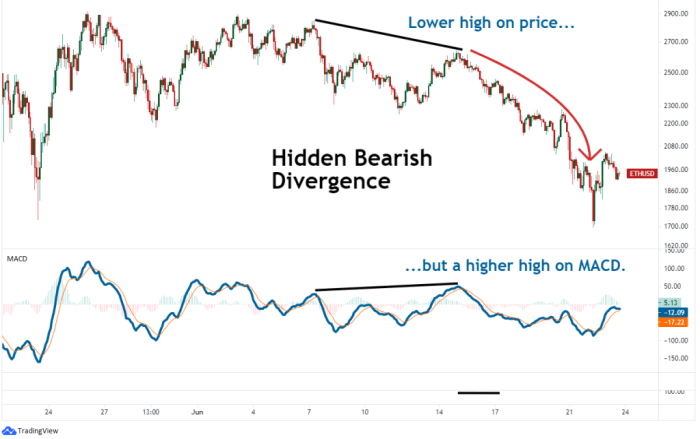
Divergence occurs when the price of an asset moves in one direction while the RSI indicator moves in another. This discrepancy can signal potential reversals or the continuation of trends. Recognizing divergence is crucial as it often indicates weakening momentum.There are two primary types of divergence to consider:
- Regular Divergence: This occurs when the price makes a new high or low, but the RSI does not follow suit. For example, if Bitcoin reaches a new high while the RSI shows a lower high, it suggests a possible bearish reversal.
- Hidden Divergence: This type of divergence occurs when the price makes a higher low, but the RSI makes a lower low. This often signals that the current trend is likely to continue. For instance, if Ethereum shows a higher low in price while the RSI falls, it may indicate a strong bullish trend that is still intact.
Understanding these divergences can help traders anticipate price movements and make informed decisions.
Significance of RSI Trendlines
Drawing trendlines on the RSI can provide additional insights into market behavior. Trendlines help visualize momentum and potential reversals more clearly than relying on RSI values alone. To draw trendlines, follow these steps:
- Identify key support and resistance levels on the RSI chart.
- Connect the significant highs or lows to form a line.
- Look for breakouts or bounces off these trendlines to inform trading decisions.
The significance of RSI trendlines lies in their ability to indicate overbought and oversold conditions more accurately. A break above a downward trendline may signal a bullish trend, while a break below an upward trendline may indicate a bearish shift.
Comprehensive Strategy Utilizing RSI for Trading, How to Use RSI Indicator for Crypto Trading
To effectively leverage the RSI for both short-term and long-term trades, it is essential to combine the indicator with additional tools and techniques. Here’s a comprehensive strategy that incorporates multiple elements:
1. Set Up the RSI
Use a standard 14-period RSI setting to gauge momentum.
2. Identify Overbought and Oversold Levels
Use the traditional levels of 70 for overbought and 30 for oversold conditions as guides in your trading.
3. Incorporate Moving Averages
Combine RSI with moving averages (e.g., 50-day or 200-day) to confirm trends. A bullish entry could occur if the RSI crosses above 30 and the price is above the moving average.
4. Use Divergence Signals
Monitor for divergence patterns that may indicate reversals or trend continuations. For example, if the price is making higher highs and the RSI is making lower highs, consider taking a cautious approach.
5. Implement Stop-Loss Orders
To manage risk, always use stop-loss orders based on your trading plan. Place stops below recent lows for long positions and above recent highs for short positions.By employing this strategy, traders can position themselves effectively for both short-term gains and long-term investments in the cryptocurrency market, utilizing the RSI’s insights to enhance their trading performance.
Final Conclusion
Source: btaguru.com
In conclusion, understanding and utilizing the RSI Indicator for crypto trading can provide traders with a strategic advantage in the ever-fluctuating market. By avoiding common pitfalls and leveraging advanced strategies, you can harness the power of the RSI to enhance your trading outcomes. Remember, successful trading is not just about following indicators, but also about understanding the market context in which these tools operate.
FAQ
What does the RSI value indicate?
The RSI value indicates whether a cryptocurrency is overbought (above 70) or oversold (below 30), helping traders identify potential reversal points.
Can the RSI be used for long-term trading?
Yes, while the RSI is often used for short-term trades, it can also help identify long-term trends when combined with other indicators.
How often should I check the RSI?
It depends on your trading strategy; day traders may check RSI multiple times a day, while swing traders might check daily or weekly.
Is RSI effective in all market conditions?
RSI can be less effective in trending markets where it may give false signals; it’s best used in conjunction with other analysis methods.
What is a good RSI setting for crypto trading?
The standard setting is 14 periods; however, traders can adjust it based on their strategy or the volatility of the cryptocurrency.